The Islamic Revolution Approach

The Islamic Revolution Approach

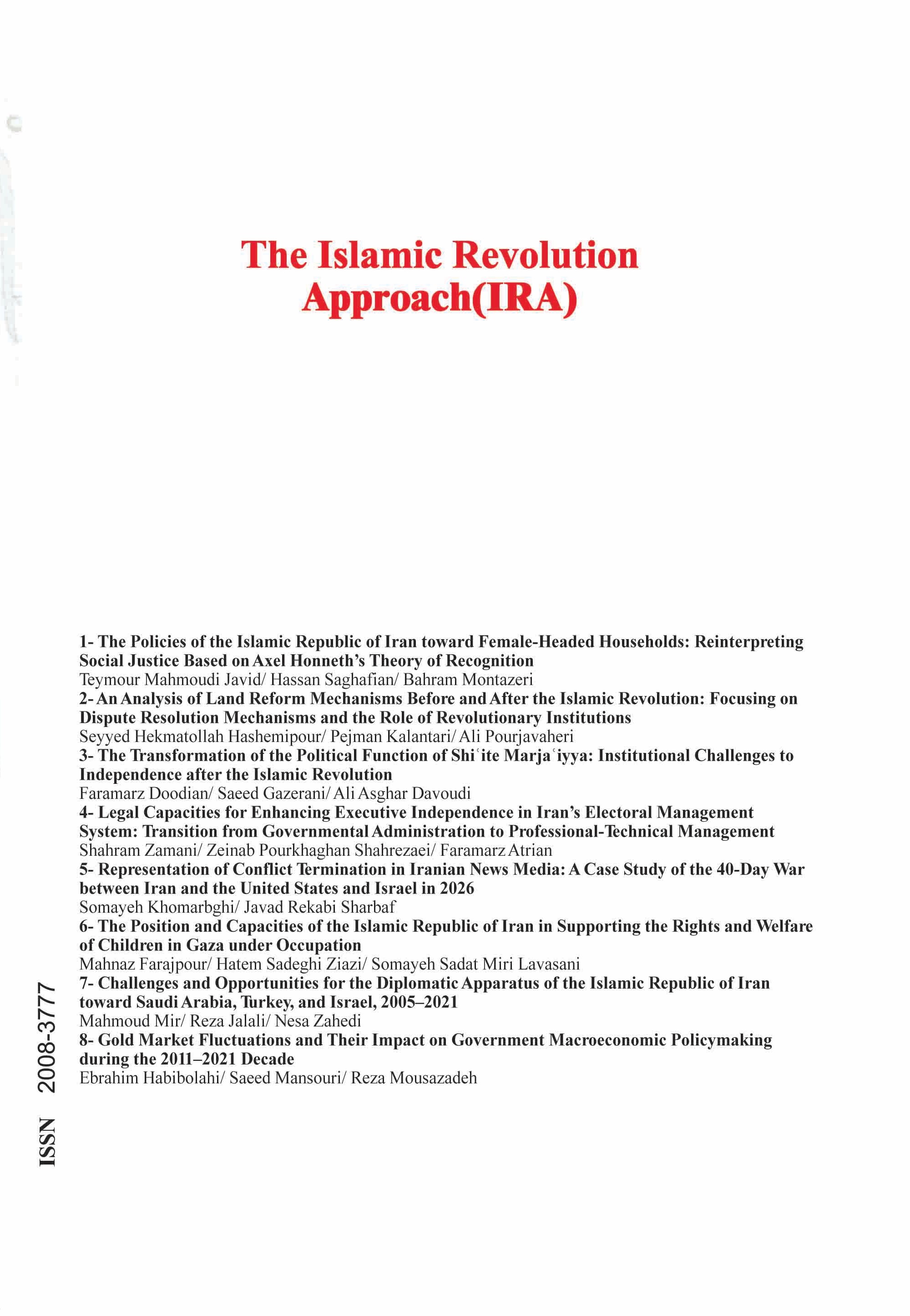
Challenges and Opportunities for the Diplomatic Apparatus of the Islamic Republic of Iran toward Saudi Arabia, Turkey, and Israel, 2005–2021 Challenges and Opportunities for the Diplomatic Apparatus of the Islamic Republic of Iran toward Saudi Arabia, Turkey, and Israel, 2005–2021

Document Type : Original Article

Authors
1 Ph.D. Student in International Relations, Central Tehran Branch, Islamic Azad University, Tehran, Iran
2 Assistant Professor of International Relations, Department of Political Science, Faculty of Law and Political Science, Islamic Azad University, Central Tehran Branch, Tehran, Iran (Corresponding Author)
3 Assistant Professor of International Relations, Faculty of Law and Political Science, Islamic Azad University, Science and Research Branch
Abstract
This study examines the challenges and opportunities facing the diplomatic apparatus of the Islamic Republic of Iran in its relations with Saudi Arabia, Turkey, and Israel during the period 2005–2021. The main question is why the capacity of Iran’s diplomatic apparatus to influence relations with these three regional actors has not been uniform. The study hypothesizes that differences in diplomatic performance are not merely a function of the intensity of external threats; rather, they result from the interaction among the nature of Iran’s relationship with each counterpart, the extent of shared interests, the degree of securitization of each case, and the position of the Ministry of Foreign Affairs within the foreign-policy decision-making structure. The research adopts a qualitative, analytical-comparative approach based on the analysis of documents, official positions, and library sources, while employing neoclassical realism as its theoretical framework. The findings indicate that, in the case of Turkey, the continuity of formal diplomatic channels, economic interdependence, and the possibility of separating areas of disagreement from those of cooperation created greater room for diplomatic action. In the Saudi case, the securitization of rivalry and the rupture of formal relations constrained diplomacy, although the possibility of returning to negotiations remained. In contrast, in the case of Israel, the absence of formal relations and the dominance of security considerations largely confined the Ministry of Foreign Affairs to indirect and multilateral diplomacy.

Introduction
The period between 2005 and 2021 was one of the most turbulent phases in the regional environment surrounding the Islamic Republic of Iran. The aftermath of the US intervention in Iraq, the Arab uprisings, the Syrian and Yemeni conflicts, the intensification of the Iranian nuclear dispute, the conclusion and subsequent weakening of the Joint Comprehensive Plan of Action, and the expansion of Israel’s ties with several Arab states substantially reshaped regional alignments. Within this changing environment, Iran faced three markedly different patterns of interaction with Saudi Arabia, Turkey, and Israel. Relations with Saudi Arabia were characterized by intense geopolitical and security rivalry, compounded by ideological and sectarian dimensions. Relations with Turkey combined competition with sustained cooperation, particularly in the economic, energy, and border-security spheres. Relations with Israel, in contrast, were shaped by structural confrontation, the absence of formal diplomatic relations, and a high degree of securitization.The central problem of this study is therefore not simply how Iran behaved toward these three actors, but why the capacity of its diplomatic apparatus varied across the three cases. The study argues that foreign policy should not be equated with the performance of the Ministry of Foreign Affairs. Iran’s regional policies emerge from a broader and multi-layered decision-making structure in which political, security, military, and ideological institutions participate with varying degrees of influence. Accordingly, the main research question asks why Iran’s diplomatic apparatus possessed greater room for maneuver in some regional relationships than in others. The hypothesis is that diplomatic effectiveness depends on the interaction among external pressures, the nature of bilateral relations, the existence of shared interests, the degree of securitization, and the domestic distribution of authority in foreign-policy decision-making.
Materials and Methods
This research adopts a qualitative, analytical-comparative approach. The empirical material consists of official documents, public statements by Iranian officials, scholarly literature, and relevant policy-oriented studies concerning Iran’s relations with Saudi Arabia, Turkey, and Israel between 2005 and 2021. Rather than organizing the analysis according to successive Iranian administrations, the study compares the three cases within a common analytical framework.Neoclassical realism provides the theoretical foundation of the study. This approach links systemic pressures to domestic intervening variables and foreign-policy outcomes. Accordingly, the analysis is conducted at three interconnected levels. The first level concerns external and regional pressures, including changes in the balance of power, regional conflicts, alliance formation, and the policies of extra-regional powers. The second level addresses domestic intervening variables, especially elite perceptions, institutional coordination, the degree of securitization of each policy file, and the relative authority of the Ministry of Foreign Affairs. The third level concerns diplomatic outcomes, including the continuity or breakdown of official channels, the management of conflict, the use of multilateral diplomacy, and the ability to exploit areas of common interest.
Discussion
The comparative analysis reveals three distinct patterns. In the Turkish case, diplomatic engagement benefited from continuous official relations, significant economic interdependence, energy cooperation, and shared concerns over territorial stability and separatism. Even during severe disagreements over Syria and regional influence, the two countries maintained political dialogue and later participated in multilateral mechanisms such as the Astana process. The principal achievement of diplomacy in this case was therefore not the elimination of conflict, but the management of competition without the collapse of the broader relationship.Relations with Saudi Arabia followed a different trajectory. Rivalry expanded across Iraq, Bahrain, Syria, and Yemen and became increasingly securitized. The rupture of diplomatic relations in 2016 significantly reduced the institutional tools available to the Ministry of Foreign Affairs. Nevertheless, unlike the Israeli case, the possibility of negotiation was never structurally eliminated. Indirect contacts and the later Baghdad talks demonstrated that diplomatic re-engagement remained possible when the costs of continued confrontation increased.The Israeli case represented the most structurally constrained environment for Iranian diplomacy. Because Iran does not maintain formal diplomatic relations with Israel, the Ministry of Foreign Affairs lacked conventional bilateral instruments. Moreover, the nuclear issue, Syria, Lebanon, missile deterrence, and relations with non-state actors were highly securitized and involved institutions beyond the Ministry’s direct authority. As a result, diplomacy was primarily indirect, multilateral, and focused on managing the international environment of the conflict rather than managing a bilateral relationship.
Conclusion
The study concludes that the effectiveness of Iran’s diplomatic apparatus cannot be explained solely by the level of external threat. Its capacity is shaped by the interaction between systemic pressures and domestic institutional conditions. Where formal channels remain open, shared interests are significant, and disagreements can be separated from cooperation, the Ministry of Foreign Affairs enjoys greater room for maneuver. Where relations become heavily securitized and decision-making shifts toward security institutions, diplomacy becomes more constrained and reactive.Accordingly, the three cases represent three different models: managed competition within cooperation in the case of Turkey, securitized rivalry with a residual capacity for negotiation in the case of Saudi Arabia, and structural confrontation dominated by indirect and multilateral diplomacy in the case of Israel. The central analytical implication is that evaluating Iranian diplomacy requires a clear distinction between the broader foreign policy of the Islamic Republic and the specific institutional capacity of its diplomatic apparatus.
Bibliography
Aghaei, S. D., & Ahmadian, H. (2010). «Relations between the Islamic Republic of Iran and Saudi Arabia: Fundamental challenges and available opportunities». Siasat, 40(3), 1–19. {in Persian}
Akbar, A. (2021). «Iran’s regional influence in light of its security concerns». Middle East Policy, 28(3–4), 186–202. https://doi.org/10.1111/mepo.12606
Alavi, S. M. A., & Dehghani Firouzabadi, S. J. (2016). «Examining the securitization process of the Islamic Republic of Iran’s nuclear activities by the pro-Israel lobby in the United States from the perspective of the Copenhagen School». Pazhohesh-haye Rahbordi-ye Siasat, 39–59. {in Persian}
Aram, A. (2019). «Iran and Saudi Arabia: Competition for influence in the Middle East». Motaleat-e Bonyadi va Karbordi-ye Jahan-e Eslam, 17, 41–59. {in Persian}
Ayman, S. G. (2014). «Turkey and Iran: Between friendly competition and fierce rivalry». Arab Studies Quarterly, 36(1), 6–26. https://doi.org/10.13169/arabstudquar.36.1.0006
Dehghanian, M., Zarei, B., Moghiseh, R., & Radmehr, M. (2025). «The impact of Saudi Arabia’s Vision 2030 on the countries of the Axis of Resistance». Ayandeh-Pazhuhi-ye Defaei, 10(36), 65–98. https://doi.org/10.22034/dfsr.2025.2033222.1802 {in Persian}
Dehghani Firouzabadi, S. J. (2011). «Neoclassical realism and the foreign policy of the Islamic Republic of Iran». Siasat-e Khareji, 25(2), 275–294. {in Persian}
Diansaei, B. (2018). «Iran and Saudi Arabia in the Middle East: Leadership and sectarianism (2011–2017)». Vestnik RUDN. International Relations, 18(1), 124–134. https://doi.org/10.22363/2313-0660-2018-18-1-124-134
Dueck, C. (2009). «Neoclassical realism and the national interest: Presidents, domestic politics, and major military interventions». In S. E. Lobell, N. M. Ripsman, & J. W. Taliaferro (Eds.), Neoclassical realism, the state, and foreign policy (pp. 139–169). Cambridge University Press. https://doi.org/10.1017/CBO9780511811869.005
Eijabi, E., Hafezzadeh, M., Namdari, N., & Karimian, R. (2025). «The probable scenario of the Zionist regime’s military threats against Iran on the horizon of 2031». Ayandeh-Pazhuhi-ye Defaei, 10(36), 167–203. https://doi.org/10.22034/dfsr.2024.2047126.1858 {in Persian}
Esfandiary, D., & Tabatabai, A. (2016). «Yemen: An opportunity for Iran–Saudi dialogue?». The Washington Quarterly, 39(2), 155–174. https://doi.org/10.1080/0163660X.2016.1204415
Fakhro, E., & Baconi, T. (2022). «A shared vision: Security convergence between the Gulf and Israel». Journal of Palestine Studies, 51(3), 50–55. https://doi.org/10.1080/0377919X.2022.2090209
Furlan, M. (2022). «Israeli-Iranian relations: Past friendship, current hostility». Israel Affairs, 28(2), 170–183. https://doi.org/10.1080/13537121.2022.2041304
Ghaeibi, M. R. (2016). «The political economy of Iran–Turkey relations during the Justice and Development Party government». Siasat-e Khareji, 30(2), 85–113. {in Persian}
International Crisis Group. (2016). Turkey and Iran: Bitter friends, bosom rivals (Middle East and North Africa Report No. 51). International Crisis Group.
Juneau, T. (2015). Squandered opportunity: Neoclassical realism and Iranian foreign policy. Stanford University Press.
Kalehsar, O. S. (2015). «Energy factor in Iran-Turkey relations». Energy & Environment, 26(5), 777–787. https://doi.org/10.1260/0958-305X.26.5.777
Kamrava, M. (2021). «Institutions and policy in Iran’s relations with the GCC». The Muslim World, 111(3), 408–424. https://doi.org/10.1111/muwo.12403
Kaye, D. D., Nader, A., & Roshan, P. (2011). Israel and Iran: A dangerous rivalry. RAND Corporation.
Keynoush, B. (2016). Saudi Arabia and Iran: Friends or foes? Palgrave Macmillan. https://doi.org/10.1007/978-1-137-58939-2
Khatami, M., & Anousheh, E. (2019). «Analysis of the conflict between Iran and the Zionist regime over Iran’s nuclear program using game theory». Ayandeh-Pazhuhi-ye Defaei, 4(13), 7–39. https://doi.org/10.22034/dfsr.2019.36541 {in Persian}
Mabon, S. (2012). «The battle for Bahrain: Iranian-Saudi rivalry». Middle East Policy, 19(2), 84–97. https://doi.org/10.1111/j.1475-4967.2012.00537.x
Mabon, S. (2018). «Muting the trumpets of sabotage: Saudi Arabia, the US and the quest to securitize Iran». British Journal of Middle Eastern Studies, 45(5), 742–759. https://doi.org/10.1080/13530194.2017.1343123
Mabon, S., Nasirzadeh, S., & Alrefai, E. (2021). «De-securitisation and pragmatism in the Persian Gulf: The future of Saudi-Iranian relations». The International Spectator, 56(4), 66–83. https://doi.org/10.1080/03932729.2021.1989183
MacGillivray, I. W. (2020). «The paradox of Turkish–Iranian relations in the Syrian crisis». Third World Quarterly, 41(6), 1046–1066. https://doi.org/10.1080/01436597.2020.1730692
Mokhtari, B., & Montazeri, H. R. (2012). «Examining patterns of conflict and cooperation in Iran–Turkey relations». Tarikh-e Ravabet-e Khareji, 13–14(52–53), 169–218. {in Persian}
Mousavi Shahidi, S. M., Vahdaninia, V., & Hosseini, S. N. (2024). «Iran at a geopolitical crossroads: Challenges arising from the probable Zangezur Corridor scenario». Ayandeh-Pazhuhi-ye Defaei, 9(35), 1–25. https://doi.org/10.22034/dfsr.2025.2047082.1856 {in Persian}
Nabavi, S. M., Safavi, S. H., & Koushki, M. S. (2020). «Developing scenarios for Iran–Turkey relations toward the 2029 horizon». Ayandeh-Pazhuhi-ye Defaei, 5(18), 7–36. https://doi.org/10.22034/dfsr.2021.141522.1441 {in Persian}
Naderi, M., & Tajik, H. (2018). «Strategic scenarios for relations between the Islamic Republic of Iran and Saudi Arabia toward the 2030 horizon». Ayandeh-Pazhuhi-ye Defaei, 3(11), 7–28. {in Persian}
Rajiv, S. S. C. (2016). «Deep disquiet: Israel and the Iran nuclear deal». Contemporary Review of the Middle East, 3(1), 47–62. https://doi.org/10.1177/2347798916632324
Reis da Silva, A. L., & Leães, R. F. (2014). «A convergência Turco-Brasileira na Declaração de Teerã (2010)». Mural Internacional, 5(2), 148–162. https://doi.org/10.12957/rmi.2014.12233
Roomi, F. (2023). «The Iran-Israel conflict: An ultra-ideological explanation». Middle East Policy, 30(2), 94–109. https://doi.org/10.1111/mepo.12687
Rose, G. (1998). «Neoclassical realism and theories of foreign policy». World Politics, 51(1), 144–172. https://doi.org/10.1017/S0043887100007814
Schweller, R. L. (2004). «Unanswered threats: A neoclassical realist theory of underbalancing». International Security, 29(2), 159–201. https://doi.org/10.1162/0162288042879913
Taliaferro, J. W., Lobell, S. E., & Ripsman, N. M. (2009). «Introduction: Neoclassical realism, the state, and foreign policy». In S. E. Lobell, N. M. Ripsman, & J. W. Taliaferro (Eds.), Neoclassical realism, the state, and foreign policy (pp. 1–41). Cambridge University Press.
Zaccara, L. (2021). «The Iranian foreign policy in turbulent times: The Arab uprisings, the nuclear deal and the GCC crisis». Revista Española de Ciencia Política, 56, 49–70. https://doi.org/10.21308/recp.56.02
Zohdi Nasab, Y., & Mahmoudi Toulash, S. (2020). «Futures study of defense cooperation among Saudi Arabia, the United Arab Emirates, and the Zionist regime against the Islamic Republic of Iran based on scenario planning». Ayandeh-Pazhuhi-ye Defaei, 5(19), 31–52. https://doi.org/10.22034/dfsr.2021.521381.1457 {in Persian}

Keywords

 
Aghaei, S. D., & Ahmadian, H. (2010). «Relations between the Islamic Republic of Iran and Saudi Arabia: Fundamental challenges and available opportunities». Siasat, 40(3), 1–19. {in Persian}
Akbar, A. (2021). «Iran’s regional influence in light of its security concerns». Middle East Policy, 28(3–4), 186–202. https://doi.org/10.1111/mepo.12606
Alavi, S. M. A., & Dehghani Firouzabadi, S. J. (2016). «Examining the securitization process of the Islamic Republic of Iran’s nuclear activities by the pro-Israel lobby in the United States from the perspective of the Copenhagen School». Pazhohesh-haye Rahbordi-ye Siasat, 39–59. {in Persian}
Aram, A. (2019). «Iran and Saudi Arabia: Competition for influence in the Middle East». Motaleat-e Bonyadi va Karbordi-ye Jahan-e Eslam, 17, 41–59. {in Persian}
Ayman, S. G. (2014). «Turkey and Iran: Between friendly competition and fierce rivalry». Arab Studies Quarterly, 36(1), 6–26. https://doi.org/10.13169/arabstudquar.36.1.0006
Dehghanian, M., Zarei, B., Moghiseh, R., & Radmehr, M. (2025). «The impact of Saudi Arabia’s Vision 2030 on the countries of the Axis of Resistance». Ayandeh-Pazhuhi-ye Defaei, 10(36), 65–98. https://doi.org/10.22034/dfsr.2025.2033222.1802 {in Persian}
Dehghani Firouzabadi, S. J. (2011). «Neoclassical realism and the foreign policy of the Islamic Republic of Iran». Siasat-e Khareji, 25(2), 275–294. {in Persian}
Diansaei, B. (2018). «Iran and Saudi Arabia in the Middle East: Leadership and sectarianism (2011–2017)». Vestnik RUDN. International Relations, 18(1), 124–134. https://doi.org/10.22363/2313-0660-2018-18-1-124-134
Dueck, C. (2009). «Neoclassical realism and the national interest: Presidents, domestic politics, and major military interventions». In S. E. Lobell, N. M. Ripsman, & J. W. Taliaferro (Eds.), Neoclassical realism, the state, and foreign policy (pp. 139–169). Cambridge University Press. https://doi.org/10.1017/CBO9780511811869.005
Eijabi, E., Hafezzadeh, M., Namdari, N., & Karimian, R. (2025). «The probable scenario of the Zionist regime’s military threats against Iran on the horizon of 2031». Ayandeh-Pazhuhi-ye Defaei, 10(36), 167–203. https://doi.org/10.22034/dfsr.2024.2047126.1858 {in Persian}
Esfandiary, D., & Tabatabai, A. (2016). «Yemen: An opportunity for Iran–Saudi dialogue?». The Washington Quarterly, 39(2), 155–174. https://doi.org/10.1080/0163660X.2016.1204415
Fakhro, E., & Baconi, T. (2022). «A shared vision: Security convergence between the Gulf and Israel». Journal of Palestine Studies, 51(3), 50–55. https://doi.org/10.1080/0377919X.2022.2090209
Furlan, M. (2022). «Israeli-Iranian relations: Past friendship, current hostility». Israel Affairs, 28(2), 170–183. https://doi.org/10.1080/13537121.2022.2041304
Ghaeibi, M. R. (2016). «The political economy of Iran–Turkey relations during the Justice and Development Party government». Siasat-e Khareji, 30(2), 85–113. {in Persian}
International Crisis Group. (2016). Turkey and Iran: Bitter friends, bosom rivals (Middle East and North Africa Report No. 51). International Crisis Group.
Juneau, T. (2015). Squandered opportunity: Neoclassical realism and Iranian foreign policy. Stanford University Press.
Kalehsar, O. S. (2015). «Energy factor in Iran-Turkey relations». Energy & Environment, 26(5), 777–787. https://doi.org/10.1260/0958-305X.26.5.777
Kamrava, M. (2021). «Institutions and policy in Iran’s relations with the GCC». The Muslim World, 111(3), 408–424. https://doi.org/10.1111/muwo.12403
Kaye, D. D., Nader, A., & Roshan, P. (2011). Israel and Iran: A dangerous rivalry. RAND Corporation.
Keynoush, B. (2016). Saudi Arabia and Iran: Friends or foes? Palgrave Macmillan. https://doi.org/10.1007/978-1-137-58939-2
Khatami, M., & Anousheh, E. (2019). «Analysis of the conflict between Iran and the Zionist regime over Iran’s nuclear program using game theory». Ayandeh-Pazhuhi-ye Defaei, 4(13), 7–39. https://doi.org/10.22034/dfsr.2019.36541 {in Persian}
Mabon, S. (2012). «The battle for Bahrain: Iranian-Saudi rivalry». Middle East Policy, 19(2), 84–97. https://doi.org/10.1111/j.1475-4967.2012.00537.x
Mabon, S. (2018). «Muting the trumpets of sabotage: Saudi Arabia, the US and the quest to securitize Iran». British Journal of Middle Eastern Studies, 45(5), 742–759. https://doi.org/10.1080/13530194.2017.1343123
Mabon, S., Nasirzadeh, S., & Alrefai, E. (2021). «De-securitisation and pragmatism in the Persian Gulf: The future of Saudi-Iranian relations». The International Spectator, 56(4), 66–83. https://doi.org/10.1080/03932729.2021.1989183
MacGillivray, I. W. (2020). «The paradox of Turkish–Iranian relations in the Syrian crisis». Third World Quarterly, 41(6), 1046–1066. https://doi.org/10.1080/01436597.2020.1730692
Mokhtari, B., & Montazeri, H. R. (2012). «Examining patterns of conflict and cooperation in Iran–Turkey relations». Tarikh-e Ravabet-e Khareji, 13–14(52–53), 169–218. {in Persian}
Mousavi Shahidi, S. M., Vahdaninia, V., & Hosseini, S. N. (2024). «Iran at a geopolitical crossroads: Challenges arising from the probable Zangezur Corridor scenario». Ayandeh-Pazhuhi-ye Defaei, 9(35), 1–25. https://doi.org/10.22034/dfsr.2025.2047082.1856 {in Persian}
Nabavi, S. M., Safavi, S. H., & Koushki, M. S. (2020). «Developing scenarios for Iran–Turkey relations toward the 2029 horizon». Ayandeh-Pazhuhi-ye Defaei, 5(18), 7–36. https://doi.org/10.22034/dfsr.2021.141522.1441 {in Persian}
Naderi, M., & Tajik, H. (2018). «Strategic scenarios for relations between the Islamic Republic of Iran and Saudi Arabia toward the 2030 horizon». Ayandeh-Pazhuhi-ye Defaei, 3(11), 7–28. {in Persian}
Rajiv, S. S. C. (2016). «Deep disquiet: Israel and the Iran nuclear deal». Contemporary Review of the Middle East, 3(1), 47–62. https://doi.org/10.1177/2347798916632324
Reis da Silva, A. L., & Leães, R. F. (2014). «A convergência Turco-Brasileira na Declaração de Teerã (2010)». Mural Internacional, 5(2), 148–162. https://doi.org/10.12957/rmi.2014.12233
Roomi, F. (2023). «The Iran-Israel conflict: An ultra-ideological explanation». Middle East Policy, 30(2), 94–109. https://doi.org/10.1111/mepo.12687
Rose, G. (1998). «Neoclassical realism and theories of foreign policy». World Politics, 51(1), 144–172. https://doi.org/10.1017/S0043887100007814
Schweller, R. L. (2004). «Unanswered threats: A neoclassical realist theory of underbalancing». International Security, 29(2), 159–201. https://doi.org/10.1162/0162288042879913
Taliaferro, J. W., Lobell, S. E., & Ripsman, N. M. (2009). «Introduction: Neoclassical realism, the state, and foreign policy». In S. E. Lobell, N. M. Ripsman, & J. W. Taliaferro (Eds.), Neoclassical realism, the state, and foreign policy (pp. 1–41). Cambridge University Press.
Zaccara, L. (2021). «The Iranian foreign policy in turbulent times: The Arab uprisings, the nuclear deal and the GCC crisis». Revista Española de Ciencia Política, 56, 49–70. https://doi.org/10.21308/recp.56.02
Zohdi Nasab, Y., & Mahmoudi Toulash, S. (2020). «Futures study of defense cooperation among Saudi Arabia, the United Arab Emirates, and the Zionist regime against the Islamic Republic of Iran based on scenario planning». Ayandeh-Pazhuhi-ye Defaei, 5(19), 31–52. https://doi.org/10.22034/dfsr.2021.521381.1457 {in Persian}