Document Type : Original Article
Authors
1
Department of Political Science, Shahreza Branch, Islamic Azad University, Shahreza, Iran
2
Department of Political Science, Shahreza Branch, Islamic Azad University, Shahreza, Iran (Corresponding Author)
Abstract
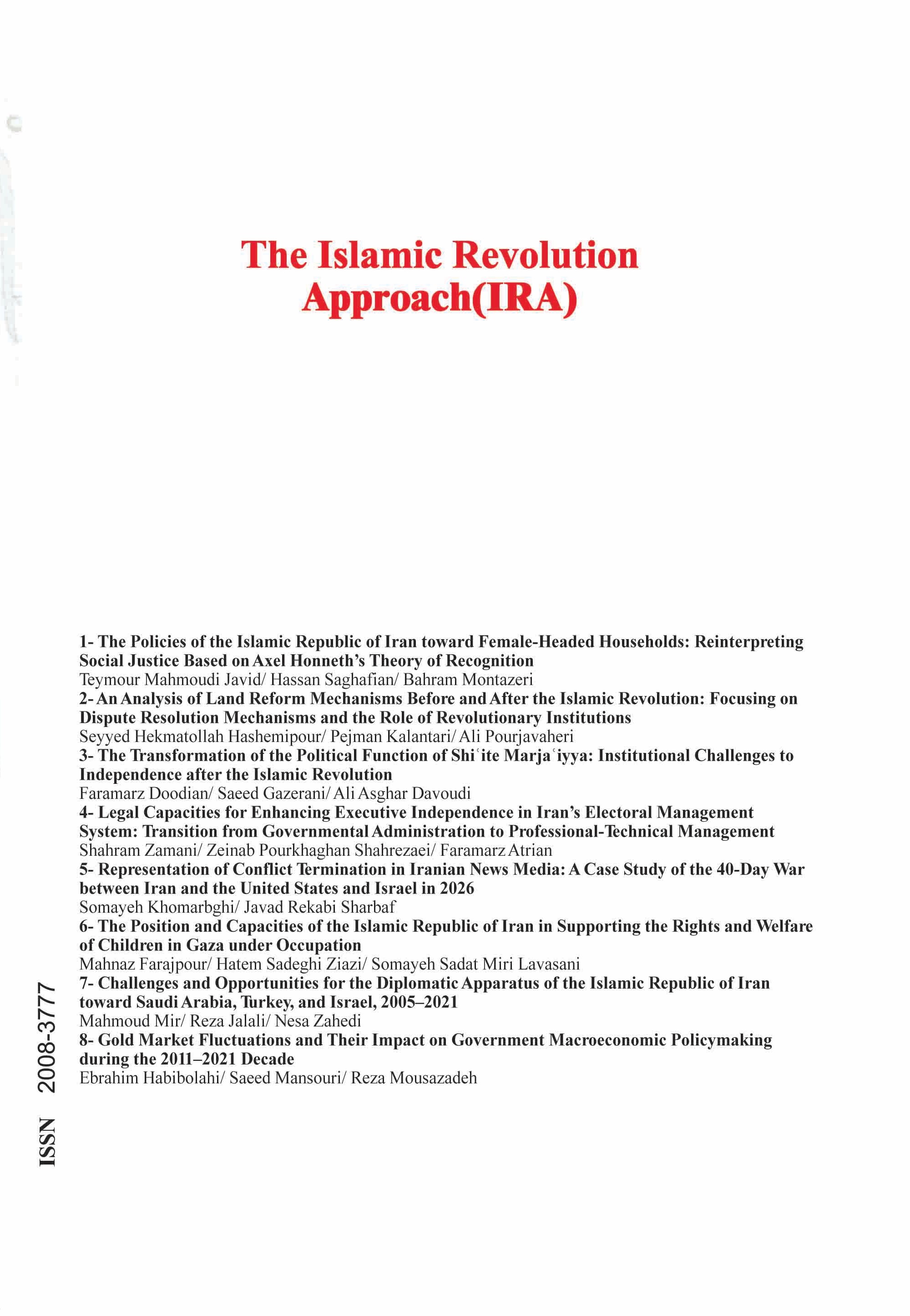
The increasing number of female-headed households in Iran has turned this group into one of the country’s most significant social and welfare concerns. During the past decades, the Islamic Republic of Iran has implemented various policies in the fields of welfare support, insurance coverage, employment, and empowerment of these women. Nevertheless, the persistence of poverty, economic insecurity, and weak social protection has raised serious questions regarding the effectiveness of these policies. The main question of this study is: what dimensions and limitations characterize the policies of the Islamic Republic of Iran toward female-headed households based on Axel Honneth’s theory of recognition? The hypothesis of the study is that although these policies have formally recognized female-headed households, recognition has remained largely incomplete due to the dominance of paternalistic and welfare-oriented approaches, institutional weaknesses, and the reduction of empowerment to merely economic dimensions. The aim of this study is to analyze the policies of the Islamic Republic of Iran regarding female-headed households through the framework of Honneth’s theory of recognition. The research adopts a qualitative approach based on content analysis of laws, policy documents, and relevant academic literature. The findings indicate that the gap between official policies and the lived experiences of women has hindered the realization of social justice and sustainable recognition.
Introduction
In recent decades, Iran has witnessed a significant increase in the number of female-headed households due to factors such as divorce, widowhood, unemployment, addiction, migration, imprisonment of male household members, and broader socio-economic transformations. This phenomenon has transformed female-headed households into one of the most important vulnerable social groups in contemporary Iran. Beyond economic deprivation, these women often face social exclusion, unstable employment, limited access to welfare services, and diminished social status.
The Islamic Republic of Iran has responded to this issue through a variety of welfare and supportive policies implemented by institutions such as the State Welfare Organization, Imam Khomeini Relief Foundation, the Vice Presidency for Women and Family Affairs, and other governmental and semi-governmental bodies. These policies have included social insurance, cash assistance, vocational training, microcredit programs, and empowerment projects. Despite these efforts, statistical evidence indicates the persistence of poverty, unemployment, weak insurance coverage, and institutional fragmentation among female-headed households. Most previous studies in Iran have focused primarily on economic poverty, employment, welfare efficiency, or social harms affecting female-headed households. However, fewer studies have examined this issue through the lens of social justice and recognition theory. Axel Honneth’s theory of recognition provides an important framework for understanding justice not merely as redistribution of resources, but also as recognition of dignity, rights, and social esteem. Accordingly, this study seeks to analyze the policies of the Islamic Republic of Iran toward female-headed households through the dimensions of legal recognition, social recognition, and supportive-moral recognition.
Materials and Methods
This study employs a qualitative research design using directed content analysis. The theoretical framework is based on Axel Honneth’s theory of recognition, particularly the categories of legal recognition, social esteem, supportive-moral recognition, and recognition crisis. The research data were collected through documentary and library-based methods. The corpus of analysis includes the Constitution of the Islamic Republic of Iran, national development plans, social security laws, welfare regulations, official reports of welfare institutions, and academic studies related to female-headed households in Iran. Relevant policy documents and institutional reports from organizations such as the State Welfare Organization and Imam Khomeini Relief Foundation were also examined. Sampling was conducted purposively, focusing on documents directly related to welfare policies, empowerment programs, gender justice, and social support for female-headed households. Data analysis proceeded through several stages: identifying meaning units, open coding, categorizing codes according to Honneth’s framework, and interpreting patterns and contradictions within Iranian social policy. To enhance validity and reliability, the study used triangulation of sources, continuous revision of coding categories, and theoretical comparison between empirical findings and recognition theory.
Discussion
The findings indicate that the policies of the Islamic Republic of Iran toward female-headed households contain three major dimensions of recognition. First, at the level of legal recognition, women have been formally recognized through constitutional principles, welfare laws, social insurance policies, and development plans. These measures have attempted to incorporate female-headed households into the sphere of social citizenship. Second, at the level of social recognition and esteem, the government has emphasized empowerment policies such as vocational training, self-employment loans, home-based occupations, and microfinance programs. These policies aim to transform women from passive welfare recipients into active economic agents. However, empowerment policies have largely remained confined to economic dimensions and traditional gender roles, particularly through the concentration on home-based and low-income occupations. Third, at the level of supportive-moral recognition, welfare institutions have provided cash assistance, healthcare support, housing aid, and social services intended to prevent complete social exclusion. Nevertheless, these policies often reproduce paternalistic and charity-oriented approaches. Female-headed households are frequently represented as dependent “clients” or vulnerable populations rather than autonomous citizens with equal dignity and agency. The study further identifies a “crisis of recognition” within Iranian social policy. Although women are formally recognized in laws and official discourse, institutional inefficiency, fragmented welfare structures, inadequate financial support, and limited implementation capacity have prevented the realization of effective and sustainable recognition. As a result, a significant gap has emerged between official policy discourse and the lived experiences of female-headed households.
Conclusion
The study concludes that the policies of the Islamic Republic of Iran toward female-headed households represent a form of incomplete recognition. While legal and welfare frameworks have formally acknowledged these women as subjects deserving support and protection, recognition has remained limited due to institutional weakness, paternalistic welfare approaches, and the reduction of empowerment to economic self-sufficiency. From the perspective of Honneth’s theory, social justice requires more than redistribution of welfare resources; it also requires recognition of dignity, equal social status, and meaningful social participation. Therefore, improving the condition of female-headed households in Iran requires a transition from merely assistance-based policies toward comprehensive recognition-based policies that address legal equality, social esteem, cultural representation, and participatory empowerment simultaneously.
Bibliography
Akbar Aghajanian & Vaida Thompson (2013) Female Headed Households in Iran(1976–2006), Marriage & Family Review, 49:2, 115-134, DOI: 10.1080/01494929.2012.728558
Barati, Mohammad Ali, & Ebrahimi Salari, Taghi. (2018). “Factors Affecting Poverty among Female-Headed Households in Iran.” Social Welfare Quarterly, 18(68), 43–85. {in Persian}
Center for Women and Family Affairs of the Presidency of the Islamic Republic of Iran. (2004). Charter of Women’s Rights and Responsibilities in the Islamic Republic of Iran. Retrieved from https://www.ekhtebar.ir/منشور-حقوق-و-مسئولیت-های-زنان-در-نظام-جم/ {in Persian}
Dadgarfard, Zahra, Fathi, Soroush, Zarei, Zahra, & Dadandish, Parvin. (2020). “Pathology of Policymaking Regarding Female-Headed Households in Iran after the Revolution.” Islamic Revolution Approach Quarterly, 14(52), 41–58. {in Persian}
Donya-e-Eqtesad Newspaper. (2015, October). “Iran’s Nine-Step Leap in Competitiveness.” Retrieved June 2017, from http://donya-e-eqtesad.com/news/938099/ {in Persian}
Eghtesad Online. (2016, November). “More than 1.3 Million Female-Headed Households Are Not Covered by Any Support Institution.” Retrieved June 2017, from http://www.eghtesadonline.com/ {in Persian}
Family and Women Analytical News Agency. (2013, May). “Women Aged 18 to 50 under the Coverage of the Welfare Organization Will Benefit from Social Insurance.” Retrieved June 2017, from http://mehrkhane.com/fa/news/6598/ {in Persian}
Forouzan, S., & Biglarian, A. (2003). “Female-Headed Households; Opportunities and Challenges.” Women’s Research Quarterly, 5, 35–58. {in Persian}
Fraser, N., & Honneth, A. (2003). Redistribution or Recognition? A Political-Philosophical Exchange. London: Verso.
Honneth, A. (1995). The Struggle for Recognition: The Moral Grammar of Social Conflicts. Cambridge: Polity Press.
Honneth, A. (2001). Recognition or Redistribution? Changing Perspectives on the Moral Order of Society. Theory, Culture & Society, 18(2-3), 43-55.
McNay, L. (2008). Against Recognition. Cambridge: Polity Press.
Naghibi, A., & Mohammadtaghi-Zadeh, M. (2014). “Legislative and Executive Contexts of Social Security for Unsupported and Badly Supported Women.” Strategic Studies on Women, 16(64), 117–157. {in Persian}
Salahedin Ghaderi, Alireza Karimi,,Somayeh Soleymani,Khadijeh Kargar Esfanabadi, The Experiences of Female-Headed Households and the Cycle of Misery (Case Study of Female-Headed Households in Karaj), Quarterly of Social Studies Research in Iran Vol. 11, No. 1:1-27, Spring 2022 Doi: 10.22059/JISR.2021.307490.1096
Shahraki, Mehdi, & Ghaderi, Simin. (2021). “Determinants of Health Expenditures among Female-Headed Households in Urban Areas of Iran.” Journal of Health Education and Health Promotion, 9(2), 133–144. {in Persian}
Tadbir Analytical Platform. (2023). Analytical Report on Insurance for Female-Headed Households. Retrieved from https://tadbirtp.ir/insurance-for-female-heads-of-the-household/ {in Persian}
Vaezi, Ahmad. (2021). “Social Justice and Its Relation to Distributive Justice.” Political Science Quarterly, 24(95), 6–25. {in Persian}
Vahedi, Roghayeh, & Khosravi Bab-Anari, Malektaj. (2020). “The Role of Non-Governmental Organizations in the Political Socialization of Female-Headed Households (With Emphasis on East Azerbaijan Province).” Islamic Revolution Approach Quarterly, 14(52), 41–58. {in Persian} Yoosefi Lebni, J., Mohammadi Gharehghani, M. A., Soofizad, G., Khosravi, B., Ziapour, A., & Irandoost, S. F. (2020). Challenges and opportunities confronting female-headed households in Iran: a qualitative study. BMC women's health, 20(1), 183.
Zarean, Mansoureh, Zarei, Masoumeh, & Honardoust, Atiyeh. (2018). “Empowerment of Female-Headed Households with Emphasis on the Fourth, Fifth, and Sixth Development Plans of the Islamic Republic of Iran.” Women in Development and Politics, 16(2), 319–338. {in Persian}
Zurn, C. F. (2015). Axel Honneth: A Critical Theory of the Social. Cambridge: Polity Press.
Keywords