The Islamic Revolution Approach

The Islamic Revolution Approach

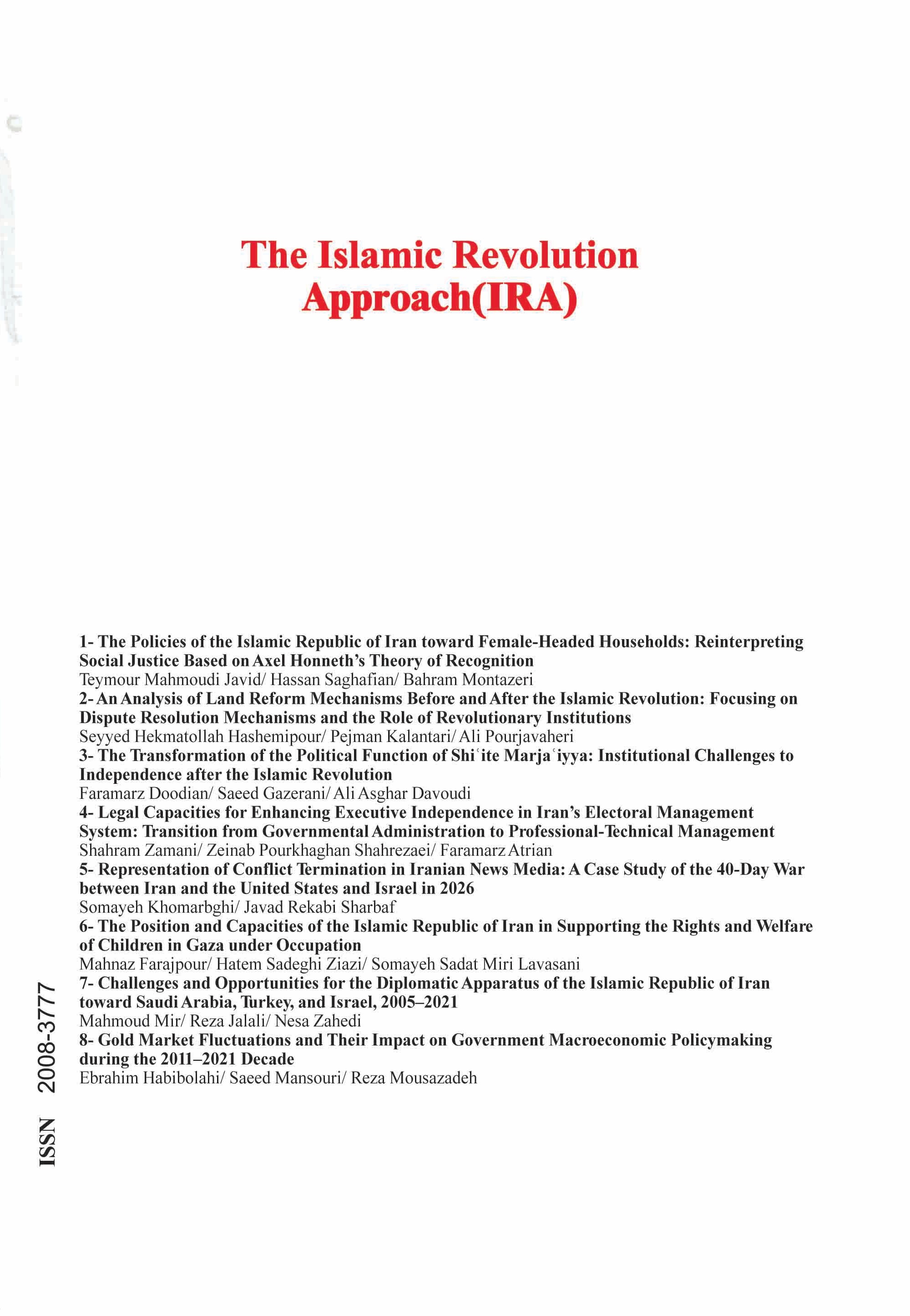
An Analysis of Land Reform Mechanisms Before and After the Islamic Revolution: Focusing on Dispute Resolution Mechanisms and the Role of Revolutionary Institutions

Document Type : Original Article

Authors
1 Department of Islamic Studies, Yasuj Branch, Islamic Azad University, Yasuj, Iran (Corresponding Author)
2 PhD Student, Department of Private Law, Yasuj Branch, Islamic Azad University, Yasuj, Iran
3 Department of Private Law, Yasuj Branch, Islamic Azad University, Yasuj, Iran
Abstract
Land reform in Iran before and after the Islamic Revolution has been a complex and multidimensional process accompanied by fundamental structural, legal, and institutional transformations. The main question of this study is how land reform mechanisms and dispute resolution institutions were formed and transformed across different periods, particularly after the Islamic Revolution. The study aims to comparatively analyze dispute resolution mechanisms and the role of revolutionary institutions in the process of land reform before and after the Revolution. The findings indicate that, during the pre-revolutionary period, land reform followed a largely political and top-down approach aimed primarily at limiting the power of large landowners and creating a new social class dependent on the state. The reforms were promoted by technocratic and modernization-oriented forces and pursued specific political and economic objectives. After the establishment of the Islamic Republic, however, approaches shifted toward greater emphasis on the rights of rural populations and the redistribution of land and economic resources, while new institutions such as the Land Allocation Headquarters, the Land Reform Council, and the Expediency Discernment Council emerged. Although the full implementation of land reform was halted in 1984 following the Guardian Council’s view that its continuation was inconsistent with Islamic law, the Expediency Discernment Council in 1991 authorized the Ministry of Agriculture to implement part of the remaining land reform regulations, thereby enabling a limited continuation of the reform process in favor of cultivators holding recognized farming rights. Judicial institutions also functioned as complementary mechanisms for resolving disputes arising from land reform, and judicial decisions have recognized the legitimacy of cultivators’ rights. After the Revolution, dispute resolution mechanisms included judicial authorities, the Land Reform Council, and the Administrative Court of Justice, which contributed to the regulation of disputes and the maintenance of legal order in this field. The study employs a descriptive-analytical method and relies on library and documentary sources.

Introduction
Land reform constitutes one of the most significant legal, economic, and social transformations in modern Iranian history. In the pre-revolutionary period, it was designed to alter the concentrated structure of landownership, weaken the position of large landowners, redefine relations between landlords and cultivators, and contribute to broader modernization policies. However, land reform was not merely an economic redistribution program; it also generated extensive legal disputes concerning ownership, tenancy, cultivators’ rights, land valuation, registration, and the validity of transfers. Following the Islamic Revolution of 1979, changes in political ideology, legal institutions, and approaches to property rights significantly altered the institutional framework governing land reform. New bodies entered the decision-making and dispute-resolution process, while earlier regulations were either reconsidered, modified, or selectively retained. The central question of this study is therefore how land reform and its dispute resolution mechanisms changed before and after the Islamic Revolution and what role revolutionary and judicial institutions played in this transformation.
Materials and Methods
The study adopts a descriptive-analytical and comparative approach based on library and documentary research. Laws, regulations, judicial decisions, institutional measures, and relevant scholarly studies concerning land reform in the two periods are examined. A process-oriented perspective is also employed to trace gradual legal and institutional changes and to identify major turning points in the development of dispute resolution mechanisms. This approach makes it possible to compare not only the formal rules governing land redistribution but also the changing roles of administrative, quasi-judicial, and judicial institutions over time.
Discussion
The findings reveal a clear transformation in both the objectives and institutional mechanisms of land reform. Before the Revolution, the Ministry of Agriculture, provincial land reform commissions, agricultural dispute settlement boards, and local courts constituted the principal mechanisms for implementing reform and resolving disputes. Legal rules also recognized the importance of customary practices in determining cultivators’ rights and landlord–tenant relations.
After the Revolution, the legal and institutional environment became more complex. The Guardian Council’s 1984 position that the continuation of certain land reform regulations was inconsistent with Islamic law interrupted the previous trajectory. Nevertheless, the Expediency Discernment Council’s 1991 resolution allowed limited implementation of remaining regulations, particularly concerning lands already possessed by cultivators with established farming rights but lacking formal ownership documents.
At the same time, institutions such as the Land Allocation Headquarters and the Land Reform Council assumed important administrative roles. The Land Reform Council retained specialized jurisdiction over particular disputes, including errors in documents issued under land reform regulations, while judicial authorities maintained a complementary role in protecting acquired rights and reviewing disputes beyond the Council’s specific jurisdiction. Decisions of the Supreme Court and the Administrative Court of Justice further contributed to defining the boundaries between administrative and judicial competence.
Conclusion
The comparison demonstrates that Iranian land reform evolved from a centralized, state-led modernization project into a more fragmented legal and institutional system shaped by revolutionary ideology, Islamic legal considerations, acquired rights, and judicial supervision. While pre-revolutionary mechanisms emphasized redistribution and administrative implementation, the post-revolutionary framework increasingly relied on interaction among the Guardian Council, Expediency Discernment Council, Ministry of Agriculture Jihad, Land Reform Council, and judicial institutions. The resulting system did not simply continue the earlier reforms; rather, it selectively preserved parts of them while redefining their legal basis and scope. The most important continuity lies in the recognition of cultivators’ established rights, whereas the major transformation concerns the diversification of institutions responsible for resolving disputes and determining the legal status of agricultural lands.
Bibliography
Abrahamian, Y. (2008). Iran between two revolutions (A. Golmohammadi & M. E. Fattahi, Trans.). Ney Publishing. {in Persian}
Amini, A. (2011). Memoirs of Ali Amini. Soureh Mehr Publishing. {in Persian}
Amiri, A., & Jamshidi, I. (2019). “A legal analysis of land reform and its consequences before and after the victory of the Islamic Revolution.” Motale’at-e Hoquq, (30), 1–10. {in Persian}
Araghi, A. (2012). Cultivators’ rights or peasants’ priority rights in Iranian law. Pardis Danesh Publishing. {in Persian}
Arsanjani, N. (2000). Dr. Arsanjani in the mirror of time. Qatreh Publishing. {in Persian}
Ashraf, A. (1982). The land and peasant question. Agah Publishing. {in Persian}
Azkia, M. (1995). Sociology of development and rural underdevelopment in Iran. Ettela’at Publishing. {in Persian}
Bashiri, A., & Chavoshi, M. S. (2016). Applied law of agricultural tenure, cultivators’ rights, root rights, karafeh, lands, properties, and gardens. Jangal Publishing. {in Persian}
Bayat, A. (2000). Street politics: The movement of the urban poor in Iran (A. Nabavi, Trans.). Shirazeh Publishing. {in Persian}
Dabirnia, A., Mashhadi, A., & Movahedipour, E. (2023). “Judicial review by the General Assembly of the Administrative Court of Justice over resolutions of the Land Reform Council.” Ta’ali-ye Hoquqi, 14(1), 97–121. {in Persian}
Ghaffari, M., & Rezazadeh, H. (2023). “Government land reform policy and the water crisis in Iran.” Dolat-Pazhuhi, 9(36), 173–208. {in Persian}
Gil Guerrero, J. (2016). The Carter administration and the fall of Iran’s Pahlavi dynasty: US–Iran relations on the brink of the 1979 revolution. Palgrave Macmillan. https://doi.org/10.1057/9781137598738
Guardian Council. (1984). Guardian Council opinion on land reform. {in Persian}
Hemmati, A. (2006). An examination of the foundations and nature of cultivators’ rights in Islamic jurisprudence and Iranian law [Master’s thesis, University of Qom]. {in Persian}
Katouzian, N. (2003). The Civil Code in the current legal order. Mizan Publishing. {in Persian}
Khosravi, A. (2008). “Cultivators’ rights from the perspective of Iranian legal sources.” Faslnameh-ye Daneshkadeh-ye Adabiyat va Olum-e Ensani, 3(10–11), 33–77. {in Persian}
Lambton, A. K. (1982). Landlord and peasant in Iran. Ministry of Culture and Higher Education Publications. {in Persian}
Land Reform Law. (1960). {in Persian}
Norouzi, A., & Shahbazi, E. (2020). “A comparative study of the Land Reform Law and its amendment bill in Iran.” Tose’e va Roosta, 23(19), 97–127. {in Persian}
Razmjou, A. A., & Razmjou, M. (2023). “Land reform and Iran’s social structures.” Tahavolat-e Siasi-Ejtemaei-ye Moaser-e Iran, 2(1), 54–78. {in Persian}
Rouhani, S. M., & Azhdari, F. (2012). “Cultivators’ rights in Iranian law.” Mohandesi-ye Keshavarzi, (37). {in Persian}
Stern, E., Margolis, J., & Hazy, J. K. (2014). Process research: Theory and methods.
Supreme Court of Iran. (2007, July 24). Session of the General Assembly of the Supreme Court concerning Unification of Judicial Procedure Case No. 84/46. https://rc.majlis.ir/fa/law/print_version/129321 {in Persian}
Van de Ven, A. H., & Poole, M. S. (1995). “Explaining development and change in organizations.” Academy of Management Review, 20(3), 510–540. https://doi.org/10.5465/amr.1995.9508080329
Zahed, F. (2008). “An overview of the Land Reform Law in Iran.” Pazhoheshnameh-ye Tarikh, 3(11), 91–122. {in Persian}
Keywords

Abrahamian, Y. (2008). Iran between two revolutions (A. Golmohammadi & M. E. Fattahi, Trans.). Ney Publishing. {in Persian}
Amini, A. (2011). Memoirs of Ali Amini. Soureh Mehr Publishing. {in Persian}
Amiri, A., & Jamshidi, I. (2019). “A legal analysis of land reform and its consequences before and after the victory of the Islamic Revolution.” Motale’at-e Hoquq, (30), 1–10. {in Persian}
Araghi, A. (2012). Cultivators’ rights or peasants’ priority rights in Iranian law. Pardis Danesh Publishing. {in Persian}
Arsanjani, N. (2000). Dr. Arsanjani in the mirror of time. Qatreh Publishing. {in Persian}
Ashraf, A. (1982). The land and peasant question. Agah Publishing. {in Persian}
Azkia, M. (1995). Sociology of development and rural underdevelopment in Iran. Ettela’at Publishing. {in Persian}
Bashiri, A., & Chavoshi, M. S. (2016). Applied law of agricultural tenure, cultivators’ rights, root rights, karafeh, lands, properties, and gardens. Jangal Publishing. {in Persian}
Bayat, A. (2000). Street politics: The movement of the urban poor in Iran (A. Nabavi, Trans.). Shirazeh Publishing. {in Persian}
Dabirnia, A., Mashhadi, A., & Movahedipour, E. (2023). “Judicial review by the General Assembly of the Administrative Court of Justice over resolutions of the Land Reform Council.” Ta’ali-ye Hoquqi, 14(1), 97–121. {in Persian}
Ghaffari, M., & Rezazadeh, H. (2023). “Government land reform policy and the water crisis in Iran.” Dolat-Pazhuhi, 9(36), 173–208. {in Persian}
Gil Guerrero, J. (2016). The Carter administration and the fall of Iran’s Pahlavi dynasty: US–Iran relations on the brink of the 1979 revolution. Palgrave Macmillan. https://doi.org/10.1057/9781137598738
Guardian Council. (1984). Guardian Council opinion on land reform. {in Persian}
Hemmati, A. (2006). An examination of the foundations and nature of cultivators’ rights in Islamic jurisprudence and Iranian law [Master’s thesis, University of Qom]. {in Persian}
Katouzian, N. (2003). The Civil Code in the current legal order. Mizan Publishing. {in Persian}
Khosravi, A. (2008). “Cultivators’ rights from the perspective of Iranian legal sources.” Faslnameh-ye Daneshkadeh-ye Adabiyat va Olum-e Ensani, 3(10–11), 33–77. {in Persian}
Lambton, A. K. (1982). Landlord and peasant in Iran. Ministry of Culture and Higher Education Publications. {in Persian}
Land Reform Law. (1960). {in Persian}
Norouzi, A., & Shahbazi, E. (2020). “A comparative study of the Land Reform Law and its amendment bill in Iran.” Tose’e va Roosta, 23(19), 97–127. {in Persian}
Razmjou, A. A., & Razmjou, M. (2023). “Land reform and Iran’s social structures.” Tahavolat-e Siasi-Ejtemaei-ye Moaser-e Iran, 2(1), 54–78. {in Persian}
Rouhani, S. M., & Azhdari, F. (2012). “Cultivators’ rights in Iranian law.” Mohandesi-ye Keshavarzi, (37). {in Persian}
Stern, E., Margolis, J., & Hazy, J. K. (2014). Process research: Theory and methods.
Supreme Court of Iran. (2007, July 24). Session of the General Assembly of the Supreme Court concerning Unification of Judicial Procedure Case No. 84/46. https://rc.majlis.ir/fa/law/print_version/129321 {in Persian}
Van de Ven, A. H., & Poole, M. S. (1995). “Explaining development and change in organizations.” Academy of Management Review, 20(3), 510–540. https://doi.org/10.5465/amr.1995.9508080329
Zahed, F. (2008). “An overview of the Land Reform Law in Iran.” Pazhoheshnameh-ye Tarikh, 3(11), 91–122. {in Persian}