The Islamic Revolution Approach

The Islamic Revolution Approach

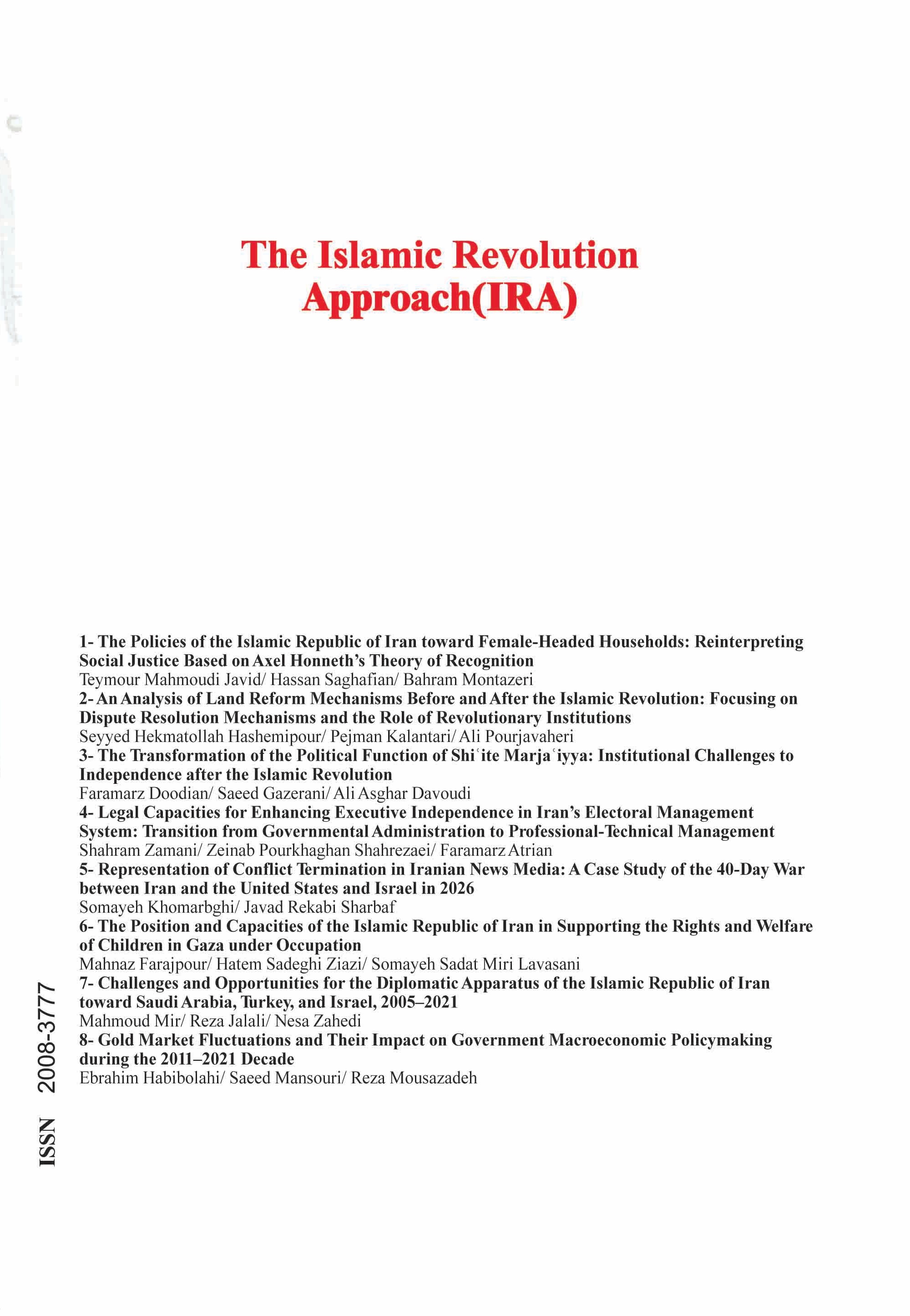
Representation of Conflict Termination in Iranian News Media: A Case Study of the 40-Day War between Iran and the United States and Israel in 2026

Document Type : Original Article

Authors
1 M.A. Graduate in Egyptian Studies, Faculty of World Studies, University of Tehran
2 Associate Professor of West Asian and North African Studies, specializing in Occupied Palestine, University of Tehran
Abstract
During military conflicts, media not only represent developments on the battlefield but also produce meanings concerning how conflicts may continue, cease, or ultimately end. From this perspective, “conflict termination” is not necessarily synonymous with “peace,” since the cessation of hostilities may be represented through such frameworks as ceasefire, negotiation, deterrence, victory, surrender, or the establishment of sustainable peace arrangements. The present study examines how conflict termination was represented in Iranian news media during the 40-day war between Iran and the United States and Israel in 2026. The main research question is: through what concepts, mechanisms, and patterns of meaning did these media represent the end of the conflict? The study employs a qualitative approach and thematic analysis. Its data consist of 20 items published by Iranian news agencies and news websites, selected and coded through purposive sampling. The findings indicate that the representation of conflict termination was not uniform and was primarily structured around two major logics: first, ending the conflict through superiority, deterrence, resistance, and the imposition of costs on the opposing side; and second, ending the conflict through ceasefire, de-escalation, dialogue, diplomacy, and a return to stability. The study therefore concludes that, within the analyzed media content, the “end of war” was not represented as a single and uncontested concept, but rather as a contested notion articulated through different and sometimes competing frameworks.

Introduction
Media do not merely report military conflicts; they also participate in producing meaning about how wars continue, how they may be stopped, and what constitutes an acceptable end to conflict. From this perspective, the end of conflict should not be equated automatically with peace. A conflict may be represented as ending through military victory, deterrence, resistance, the imposition of costs on the adversary, ceasefire, negotiation, de-escalation, or the establishment of more durable arrangements of peace. This study examines how Iranian news media represented the end of conflict during the 40-day war between Iran and the United States and Israel in 2026. The central question is: through what concepts, mechanisms, and meaning-making patterns did Iranian media construct the possible pathways toward ending the conflict? The theoretical framework is based primarily on Johan Galtung’s peace journalism approach, particularly the distinction between war journalism and peace journalism, as well as the concepts of negative peace, positive peace, and cultural violence. In this framework, media discourse is treated not as a neutral reflection of events but as an active site in which war, resistance, ceasefire, diplomacy, deterrence, and peace are framed and contested.
Materials and Methods
The study adopts a qualitative, descriptive-analytical design and uses thematic analysis as its principal method of data analysis. The research corpus consists of 20 news and analytical texts published by Iranian news agencies and media outlets. These texts were selected through purposive sampling on the basis of their direct relevance to the representation of conflict termination. Selection criteria included explicit references to ceasefire, ending the war, negotiation, de-escalation, stability, resistance, deterrence, retaliation, and possible pathways out of the conflict. The materials included news reports, interviews, commentaries, and official statements from a diverse range of Iranian media. The analytical process involved repeated reading, initial coding, clustering of related codes, and the development of broader themes. Major themes included resistance and retaliation, ceasefire and de-escalation, diplomacy and political settlement, religious representation of war, collective identity and social mobilization, and the humanitarian and economic consequences of conflict. The final thematic structure was then interpreted through the framework of peace journalism.
Discussion
The findings indicate that Iranian media did not produce a uniform representation of conflict termination. Instead, two broad and competing logics emerged. The first framed the end of conflict through resistance, deterrence, retaliation, military superiority, and the imposition of costs on the adversary. Within this logic, terms such as victory, destruction of the enemy, decisive response, revenge, and continued resistance were prominent. Some reports also linked this framing to religious symbols, sacred narratives, collective identity, and social mobilization. The second logic represented the end of conflict through ceasefire, de-escalation, diplomacy, negotiation, regional stability, and the prevention of further escalation. In these texts, war was framed as a costly and manageable crisis rather than as a confrontation that necessarily had to continue until total victory. The coding process therefore revealed a media field oscillating between war-oriented and peace-oriented narratives rather than conforming fully to either one.
Conclusion
The study concludes that “ending the war” was not represented as a single or consensual concept in the Iranian media sample. Rather, it functioned as a contested category shaped by different understandings of security, resistance, diplomacy, legitimacy, and peace. Some media texts presented deterrence, endurance, and military pressure as the necessary route to ending the conflict, whereas others emphasized ceasefire, dialogue, de-escalation, and political management. The findings therefore suggest a hybrid media environment in which the logics of war journalism and peace journalism coexist. The significance of this finding is that media representations of conflict termination do not merely describe possible outcomes; they also help define which outcomes appear legitimate, realistic, or desirable. Accordingly, the study shows that understanding media discourse on war requires attention not only to how conflict is narrated, but also to how its possible ending is imagined and framed.
Bibliography
Anderson, B. (2020). Imagined communities: Reflections on the origin and spread of nationalism. In The new social theory reader (pp. 282–288). Routledge.
Atanesyan, A. (2020). Media framing on armed conflicts: Limits of peace journalism on the Nagorno-Karabakh conflict. Journal of Intervention and Statebuilding, 14(4), 534–550. https://doi.org/10.1080/17502977.2020.1780018
Bellah, R. N. (2005). Civil religion in America. Daedalus, 134(4), 40–55.
Bowen, G. A. (2009). Document analysis as a qualitative research method. Qualitative Research Journal, 9(2), 27–40.
Braun, V., & Clarke, V. (2006). Using thematic analysis in psychology. Qualitative Research in Psychology, 3(2), 77–101.
Burton, J. (1991). Conflict resolution as a political philosophy. Global Change, Peace & Security, 3(1), 62–72.
Chomsky, N. (2011). Media control: The spectacular achievements of propaganda. Seven Stories Press.
Creswell, J. W., & Poth, C. N. (2016). Qualitative inquiry and research design: Choosing among five approaches. Sage.
Dastgheib, S. A. R., Rezaei, M. T., & Jalalian, A. (2021). Reformist and critical positions of the Islamic Republic of Iran toward the structures of international organizations from the perspective of Ayatollah Khamenei. Faslnameh-ye Rahyaft-e Enghelab-e Eslami, 15(57), 105–124. [in Persian]
Donya-e Eqtesad. (2026, April 19). Pezeshkian: Iran does not seek to expand the war; continuation of the conflict benefits neither side. Donya-e Eqtesad. [in Persian]
Epple, T. (2021). Peace agreements, the media, and communication. Political Settlements Research Programme. (Edinburgh Research)
Etemad. (2024, August 27). There is no way out of the crises except through a ceasefire. Etemad. [in Persian]
Fars News Agency. (2026). The path to salvation lies in resistance; do not fear this enemy. Fars News Agency. [in Persian]
Galtung, J. (1969). Violence, peace, and peace research. Journal of Peace Research, 6(3), 167–191.
Galtung, J. (1990). Cultural violence. Journal of Peace Research, 27(3), 291–305.
Galtung, J. (2002). Peace journalism: A challenge. In W. Kempf & H. Luostarinen (Eds.), Journalism and the new world order (pp. 259–272). Nordicom.
Girard, R. (1977). Violence and the sacred. Johns Hopkins University Press.
Hackett, R. A. (2007). Journalism versus peace? Notes on a problematic relationship. Global Media Journal: Mediterranean Edition, 2(1), 47–53.
Halbwachs, M. (2020). On collective memory. University of Chicago Press.
Hall, S., Evans, J., & Nixon, S. (2024). Representation: Cultural representations and signifying practices.
Hashemian Jazi, M., Hashemi, S. H., & Shams Nateri, M. E. (2022). The approach of the Islamic Republic of Iran to fundamental rights and freedoms with emphasis on crimes against national security. Faslnameh-ye Rahyaft-e Enghelab-e Eslami, 16(60), 29–44. [in Persian]
Herman, E. S., & Chomsky, N. (2021). Manufacturing consent. In Power and inequality (pp. 198–206). Routledge.
ILNA. (2026, March 26). Continuation of the war benefits neither side. Iranian Labour News Agency (ILNA). [in Persian]
Islamic Republic of Iran Broadcasting. (2026, April 19). The honorable people of Islamic Iran will remain present in the field until the enemy is defeated. IRIB News. [in Persian]
Islamic Republic News Agency (IRNA). (2026). Asia concerned about the consequences of aggression against Iran; emphasis on diplomacy and regional stability. IRNA. [in Persian]
Islamic Republic News Agency (IRNA). (2026). Chamran: The demand of all people is final victory and the destruction of the enemy. IRNA. [in Persian]
Islamic Republic News Agency (IRNA). (2026). Ministry of Defense: Punishment of the American-Zionist enemy continues. IRNA. [in Persian]
Islamic Republic News Agency (IRNA). (2026). Member of the Assembly of Experts: Iran’s decisive response to any aggression will be deterrent and devastating. IRNA. [in Persian]
Jomhor News. (2025, June 19). Iran’s crushing attacks on the occupied territories; Tel Aviv under fire! Jomhor News. [in Persian]
Kordbacheh Hosseinabad, M., Asgarkhani, A., Moradi, M., & Mirabbasi, S. B. (2022). Examining the responsibility of the Security Council regarding the identification of the aggressor in war: A case study of Iraq’s war against Iran. Faslnameh-ye Rahyaft-e Enghelab-e Eslami, 16(60), 143–160. [in Persian]
Lee, S. T., & Maslog, C. C. (2005). War or peace journalism? Asian newspaper coverage of conflicts. Journal of Communication, 55(2), 311–329. https://doi.org/10.1111/j.1460-2466.2005.tb02674.x (Wiley Online Library)
Lincoln, Y. S., & Guba, E. G. (1985). Naturalistic inquiry. Sage.
Lynch, J., & McGoldrick, A. (2005). Peace journalism. Hawthorn Press.
Mehr News Agency. (2026, February 28). Ayatollah Nouri Hamedani’s fatwa on avenging the blood of the Leader of the Revolution. Mehr News Agency. [in Persian]
Mehr News Agency. (2026, February 28). Hamzeh Seyyed al-Shohada Headquarters: The recent crime will not go unanswered. Mehr News Agency. [in Persian]
Mehr News Agency. (2026, February 28). People of Semnan Province: A severe and heavy revenge against the enemy. Mehr News Agency. [in Persian]
Mehr News Agency. (2026, February 28). Raising the well-known flag of revenge at Jamkaran Mosque. Mehr News Agency. [in Persian]
Mehr News Agency. (2026, March 1). Severe revenge against those responsible for and ordering the martyrdom of the Leader is among the people’s demands. Mehr News Agency. [in Persian]
Nohrstedt, S. A., & Ottosen, R. (2008). War journalism in the threat society: Peace journalism as a strategy for challenging the mediated culture of fear? Conflict & Communication Online, 7(2).
Patton, M. Q. (2014). Qualitative research & evaluation methods: Integrating theory and practice. Sage.
Rahnaward, P., Salahi, S., & Asgarkhani, A. (2020). Examining the security and environmental challenges of Iraq and Iran following the U.S. military invasion in 2003. Faslnameh-ye Rahyaft-e Enghelab-e Eslami, 14(51), 173–196. [in Persian]
Richmond, O. P. (2003). Peace in international relations. Routledge.
Schmitt, C. (2005). Political theology: Four chapters on the concept of sovereignty. University of Chicago Press.
Tabatabaei, S. M., & Hejazi, A. (2016). Preserving Islamic identity and ontological security in the foreign policy of the Islamic Republic of Iran from the perspective of the Supreme Leader. Faslnameh-ye Rahyaft-e Enghelab-e Eslami, 10(34), 95–116. [in Persian]
Tabnak. (2026, April 6). Qatar emphasizes the necessity of ending the war and restoring stability to the region. Tabnak. [in Persian]
Tabnak. (2026, May 24). Hezbollah’s new deadly strike on Haifa. Tabnak. [in Persian]
Tabnak. (2026, May 28). Images of Iran’s heavy missile attack in response to the U.S. early-morning aggression. Tabnak. [in Persian]
Tasnim News Agency. (2026, May 22). Hezbollah’s third deadly strike against Israeli forces in Margaliot. Tasnim News Agency. [in Persian]
Young Journalists Club. (2024, April 14). The region and the world cannot tolerate another war. Young Journalists Club. [in Persian]
Keywords

 
Anderson, B. (2020). Imagined communities: Reflections on the origin and spread of nationalism. In The new social theory reader (pp. 282–288). Routledge.
Atanesyan, A. (2020). Media framing on armed conflicts: Limits of peace journalism on the Nagorno-Karabakh conflict. Journal of Intervention and Statebuilding, 14(4), 534–550. https://doi.org/10.1080/17502977.2020.1780018
Bellah, R. N. (2005). Civil religion in America. Daedalus, 134(4), 40–55.
Bowen, G. A. (2009). Document analysis as a qualitative research method. Qualitative Research Journal, 9(2), 27–40.
Braun, V., & Clarke, V. (2006). Using thematic analysis in psychology. Qualitative Research in Psychology, 3(2), 77–101.
Burton, J. (1991). Conflict resolution as a political philosophy. Global Change, Peace & Security, 3(1), 62–72.
Chomsky, N. (2011). Media control: The spectacular achievements of propaganda. Seven Stories Press.
Creswell, J. W., & Poth, C. N. (2016). Qualitative inquiry and research design: Choosing among five approaches. Sage.
Dastgheib, S. A. R., Rezaei, M. T., & Jalalian, A. (2021). Reformist and critical positions of the Islamic Republic of Iran toward the structures of international organizations from the perspective of Ayatollah Khamenei. Faslnameh-ye Rahyaft-e Enghelab-e Eslami, 15(57), 105–124. [in Persian]
Donya-e Eqtesad. (2026, April 19). Pezeshkian: Iran does not seek to expand the war; continuation of the conflict benefits neither side. Donya-e Eqtesad. [in Persian]
Epple, T. (2021). Peace agreements, the media, and communication. Political Settlements Research Programme. (Edinburgh Research)
Etemad. (2024, August 27). There is no way out of the crises except through a ceasefire. Etemad. [in Persian]
Fars News Agency. (2026). The path to salvation lies in resistance; do not fear this enemy. Fars News Agency. [in Persian]
Galtung, J. (1969). Violence, peace, and peace research. Journal of Peace Research, 6(3), 167–191.
Galtung, J. (1990). Cultural violence. Journal of Peace Research, 27(3), 291–305.
Galtung, J. (2002). Peace journalism: A challenge. In W. Kempf & H. Luostarinen (Eds.), Journalism and the new world order (pp. 259–272). Nordicom.
Girard, R. (1977). Violence and the sacred. Johns Hopkins University Press.
Hackett, R. A. (2007). Journalism versus peace? Notes on a problematic relationship. Global Media Journal: Mediterranean Edition, 2(1), 47–53.
Halbwachs, M. (2020). On collective memory. University of Chicago Press.
Hall, S., Evans, J., & Nixon, S. (2024). Representation: Cultural representations and signifying practices.
Hashemian Jazi, M., Hashemi, S. H., & Shams Nateri, M. E. (2022). The approach of the Islamic Republic of Iran to fundamental rights and freedoms with emphasis on crimes against national security. Faslnameh-ye Rahyaft-e Enghelab-e Eslami, 16(60), 29–44. [in Persian]
Herman, E. S., & Chomsky, N. (2021). Manufacturing consent. In Power and inequality (pp. 198–206). Routledge.
ILNA. (2026, March 26). Continuation of the war benefits neither side. Iranian Labour News Agency (ILNA). [in Persian]
Islamic Republic of Iran Broadcasting. (2026, April 19). The honorable people of Islamic Iran will remain present in the field until the enemy is defeated. IRIB News. [in Persian]
Islamic Republic News Agency (IRNA). (2026). Asia concerned about the consequences of aggression against Iran; emphasis on diplomacy and regional stability. IRNA. [in Persian]
Islamic Republic News Agency (IRNA). (2026). Chamran: The demand of all people is final victory and the destruction of the enemy. IRNA. [in Persian]
Islamic Republic News Agency (IRNA). (2026). Ministry of Defense: Punishment of the American-Zionist enemy continues. IRNA. [in Persian]
Islamic Republic News Agency (IRNA). (2026). Member of the Assembly of Experts: Iran’s decisive response to any aggression will be deterrent and devastating. IRNA. [in Persian]
Jomhor News. (2025, June 19). Iran’s crushing attacks on the occupied territories; Tel Aviv under fire! Jomhor News. [in Persian]
Kordbacheh Hosseinabad, M., Asgarkhani, A., Moradi, M., & Mirabbasi, S. B. (2022). Examining the responsibility of the Security Council regarding the identification of the aggressor in war: A case study of Iraq’s war against Iran. Faslnameh-ye Rahyaft-e Enghelab-e Eslami, 16(60), 143–160. [in Persian]
Lee, S. T., & Maslog, C. C. (2005). War or peace journalism? Asian newspaper coverage of conflicts. Journal of Communication, 55(2), 311–329. https://doi.org/10.1111/j.1460-2466.2005.tb02674.x (Wiley Online Library)
Lincoln, Y. S., & Guba, E. G. (1985). Naturalistic inquiry. Sage.
Lynch, J., & McGoldrick, A. (2005). Peace journalism. Hawthorn Press.
Mehr News Agency. (2026, February 28). Ayatollah Nouri Hamedani’s fatwa on avenging the blood of the Leader of the Revolution. Mehr News Agency. [in Persian]
Mehr News Agency. (2026, February 28). Hamzeh Seyyed al-Shohada Headquarters: The recent crime will not go unanswered. Mehr News Agency. [in Persian]
Mehr News Agency. (2026, February 28). People of Semnan Province: A severe and heavy revenge against the enemy. Mehr News Agency. [in Persian]
Mehr News Agency. (2026, February 28). Raising the well-known flag of revenge at Jamkaran Mosque. Mehr News Agency. [in Persian]
Mehr News Agency. (2026, March 1). Severe revenge against those responsible for and ordering the martyrdom of the Leader is among the people’s demands. Mehr News Agency. [in Persian]
Nohrstedt, S. A., & Ottosen, R. (2008). War journalism in the threat society: Peace journalism as a strategy for challenging the mediated culture of fear? Conflict & Communication Online, 7(2).
Patton, M. Q. (2014). Qualitative research & evaluation methods: Integrating theory and practice. Sage.
Rahnaward, P., Salahi, S., & Asgarkhani, A. (2020). Examining the security and environmental challenges of Iraq and Iran following the U.S. military invasion in 2003. Faslnameh-ye Rahyaft-e Enghelab-e Eslami, 14(51), 173–196. [in Persian]
Richmond, O. P. (2003). Peace in international relations. Routledge.
Schmitt, C. (2005). Political theology: Four chapters on the concept of sovereignty. University of Chicago Press.
Tabatabaei, S. M., & Hejazi, A. (2016). Preserving Islamic identity and ontological security in the foreign policy of the Islamic Republic of Iran from the perspective of the Supreme Leader. Faslnameh-ye Rahyaft-e Enghelab-e Eslami, 10(34), 95–116. [in Persian]
Tabnak. (2026, April 6). Qatar emphasizes the necessity of ending the war and restoring stability to the region. Tabnak. [in Persian]
Tabnak. (2026, May 24). Hezbollah’s new deadly strike on Haifa. Tabnak. [in Persian]
Tabnak. (2026, May 28). Images of Iran’s heavy missile attack in response to the U.S. early-morning aggression. Tabnak. [in Persian]
Tasnim News Agency. (2026, May 22). Hezbollah’s third deadly strike against Israeli forces in Margaliot. Tasnim News Agency. [in Persian]
Young Journalists Club. (2024, April 14). The region and the world cannot tolerate another war. Young Journalists Club. [in Persian]